jeta
jeta


From Harvard to Mirditë and back again: An anthropological expedition with a twist
- Published in English/French
- Nga: Rafaela Prifti, MA Cultural Anthropology - USA

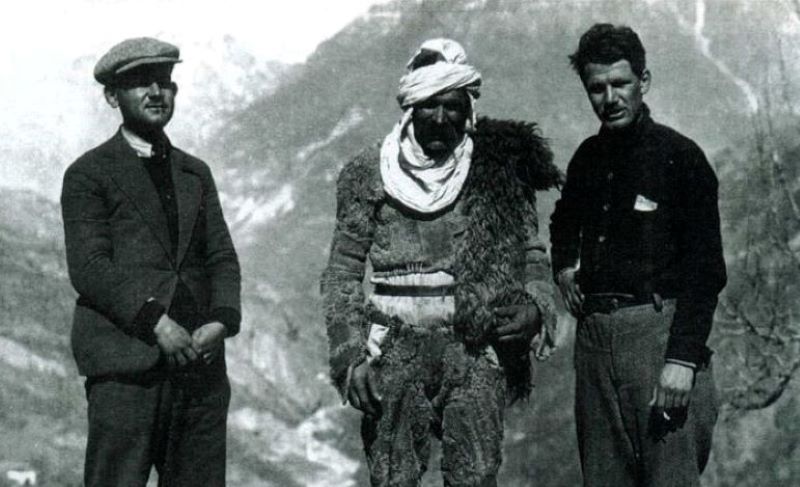
The first striking fact about the story of Through Mirdita in Winter is that it originates from Harvard University and, the second, is that, chronologically, the release of the book and its translation span from the early years of Albanian American relations to the renewal period of the diplomatic ties between two countries. There is one more standout feature that makes the publication unique. In its core, the book is an ethnographic work written by Stavre Frashëri, guide and interpreter of American anthropologist, Professor Cartlon Coon, who conducted fieldwork in Northern Albania in 1929-1930.
Professor Coon's work has been credited as "a worthy contribution to knowledge of the Albanian people in the area of anthropology and related fields." (1) Neither the Albanian, nor the American had been in Mirditë prior to 1929 which means both were first-time visitors in the region, when they first set foot there. It was the Harvard graduate from the Greater Boston area who was the initiator of the expedition that produced three books: Përmes Mirditës në Dimër (Korçë, 1930), The Mountains of Giants (1949) Thorough Mirditë in Winter (New York, 2022). In cultural anthropology, the story represents a case of the observer versus the observed.
Stavre Frashëri was genuinely grateful to have been presented with the opportunity to go to "the land of valor, about which many foreigners had written", he writes in the Preface. Up until the arrival of Professor Coon of Harvard to do studies in anthropology in Northern Albania, Frashëri, an instructor at the American Missionary School in Tirana, admits that he was one of the Albanians who had not visited other parts of Albania.
So, they both go on a trip North. Both were impressed by the preservation of an old cultural and social system in which "family and kin are the main social units" giving considerationto the interplay of cultural and environmental aspects of life in Mirditë. At the end of the expedition, one publishes a physical anthropology study, the other a travel account of the same research expedition.
For the purposes of the book, Frashëri singled out one particular area out of the region, namely Mirditë. While Coon wrote for science which implies academic impartiality, Frashëri's stated intention was the accuracy of the foreigners account but also, to arouse the Albanians' interest about "our Highlands" as the author puts it. Seen as a tandem, these books, form a long-lasting affiliation that mirrors the Albanian American relations.
When, in the Fall, Winter and Spring of 1929-1930, Professor Coon, accompanied by his wife, visited Albania, it was with the stated intention of doing research with an interest in the main outline of the culture as a whole and only in those details that bear specifically on the question of "who are the Geghs and how did they acquire their present anatomical characteristics?" It was not until 1950, however, that Coon's book The Mountains of Giants; A Racial and Cultural Study of the North Albanians Mountains Geghs was published.
During that expedition Stavre Frashëri, his guide and interpreter, kept meticulous notes of the trip. Shortly after the expedition, Frashëri's account Through Mirditë in Winter was published in Albania in 1930. His goal, he claimed, was to describe the highlands of Albania as seen by an Albanian, and thus juxtapose his account to the narrative "by foreign visitors to our country." Admittedly, Frashëri was fact-checking Carltoon Coon, in the course of the expedition. As mentioned, in the Preface of Përmes Mirditës në Dimër, he writes that his primary concern was accuracy of the foreigner's accuracy. And although the two books cover some of the same ethnographic territory, the Albanian account is a unique case, for when added to that of Coon, it provides us with two perspectives of the "same events" - that of a trained anthropologist doing fieldwork, and that of an educated insider exploring a remote part of his own country for the first time.
By the 1930s Albanians had established communities in Western Europe and had crossed the Atlantic Ocean, yet the land north of Shkumbin river was thought of as an area of "primitive" culture, poverty and outlawry. So, while accompanying Coon, Frashëri seized the chance to observe and write about the Mirditë social organization, family life, gender roles, blood feuds, weddings, death rituals. Frashëri noted the names of villages and the routes with the same diligence and attention that he described the interior of residences where the team spent the night, the kulla - the typical square shaped tower built for defensive purposes.
In attempting a portrait of the Mirditë people, Frasheri recorded the hardships and shortages the inhabitants had to face. He also recorded the names of hosts and the conversations that took place around the table. The material and economic scarcity however contrasted sharply with their untarnished appreciation of life in its fullest and generosity of spirit.
Their lives revolved around granting and receiving honor, hospitality, respect for one's social status and rank and a deep veneration for clergy. Frashëri, nevertheless, is critical of the low status of women and of the ever-present tragedies resulting from blood-feuds. He goes as far as venturing his own ideas for the advancement of the Mirdite people.
In observing Professor Coon at work, Frashëri narrates the reactions of the locals as the host would ask the men in a locality to go and be measured. Indeed Coon was conducting fieldwork as the first American physical anthropologist to set foot in Albania with the intention of actually doing a study on the typology of the Albanian Highlander. Undoubtedly, Coon benefited from and added to the body of literature by British and Americans who had trekked to those mountains before him.
The search for answers revolving around the earliest Dynarics (Dynarid) unearthed in Mesopotamia dating from the Bronx and Cooper Age brought Harvard graduates like Professor Coon to Mirditë. His theory of typology, although controversial and outdated, considers the ecophenotypic variation as a function of life station, which led him to study the the uncertain contributions of heredity and environment. In this regard, The Mountains of Giants provides a cultural context of the social and economic implications of the Gegh household, or the economics of men's clothing and equipment production. Here is how authors make their observations about smoking in a social context: Coon notes its immediate socializing nature as "a ready means of polite interaction for men give each other cigarettes..." while Frashëri records the actual event without offering an interpretation or scientific characterization.
The presentation of Greetings and Oaths is of particular interest. Any greeting however trivial entails more than a handshake and a quick polite exchange. As Frashëri explains, it involves a solemn touch on both temples, and a lengthy inquiry after one's health, all done with a certain formality. One has to take time when greeting, as a matter that cannot be rushed, nor taken lightly without risking to antagonize the party being greeted. There is a "ritualistic stalling" quality to it, as if to show absence of ill-intentions on both sides. Exchanging health-related questions about family members and offering the right salutations for each answer, assures time for holding at bay rushed decisions and dispelling any suspicions. And when it comes to hospitality, Mirdita is without compare. He writes "the guest will find an open door everywhere in this region, where he is greeted with the words: "Welcome! God has brought you here!"
Coon who was President of the American Association of Physical Anthropologists, set out to produce an anthropometric study of the "Mountain Geghs" as he described them, whereas Frashëri tried to capture that "special character" about Mirditë in his account Përmes Mirditës në Dimër. That was in 1930, the first decade of the American Albanian diplomatic relations.
Thirty years later and more than seven thousand kilometers away, at an important Vatra event, two main protagonists meet in Boston and the story line moves to the next chapter. In the summer of 1960, Peter Prifti, was organizing a week-long seminar on Albanian Studies of the Pan-Albanian Federation of Vatra in his capacity as the Secretary of the Organization. One of the speakers he had invited to address the seminar along with Bishop Noli, Professor Thomas Nassi, and Arshi Pipa, was Professor Coon. He accepted the invitation and delighted the audience with personal stories with Albanians during the time of his 1929 expedition in Albania, remembers Peter.
Years later, Professor Coon asked Mr. Prifti to translate Stavre Frashëri's book and Peter agreed to do it. In 1979 the translation was completed and the manuscript was shelved in the repository of the Harvard's University's Peabody Museum of Archaeology and Ethnology for another twenty years. In 1999, within the first decade of the reestablishing of the American Albanian ties, the Manager of Publication at Peabody favored the publication of the English translation believing that it made more sense to publish the manuscript than to let it rest in the Peabody storage, writes Peter Prifti in the Acknowledgements of Through Mirditë in Winter. In 2001, the East European Monographs published the work making it available to all English readers.
With the support of scholars, editors and consultants along the way, an American anthropologist, an Albanian interpreter/guide, and a former Vatra Secretary, contributed to make possible a publication that is not only available in two languages, Albanian and English, but one that has a narrative of its own:
Through Mirditë in Winter, Stavre Th. Frashëri. Translated into English from the Original in Albanian by Peter R. Prifti, East European Monographs, Boulder Distributed by Columbia University Press, New York, 2002.
©Rafaela Prifti