Jeta Dedja


Traditions and Meanings, Old and New - By Rafaela Prifti
- Published in English/French
 Rafaela Prifti, USA
The celebratory rituals of luck become more intense at moments of passage whether in the life of an individual or a whole group. One fitting junction is the passing of the old year and welcoming the new one. The intense nature of the year 2020 and the shared intent on prompted my initial curiosity to collect some traditions from friends and family noting my observations in the context of social anthropology.
The assemblage is a collage of cultural snapshots around the world that highlights differences and similarities connected with a particular celebration. The wide range of symbolic rituals from domestic cleaning, getting a haircut, to cooking a whole slew of food items aim to a single wish for prosperity and health in the coming year.
The experience of the year 2020 is extraordinary in that the worldwide phenomenon of Covid-19 is imprinted on our collective human memory. It is marked as the year that changed us since it is believed to have long-lasting impact in all areas: health, education, politics, economy, markets. However, in my view, the New Year traditions shared by many cultures underscore the common theme of a favorable future that is typical for all endings that are also beginnings. Symbolism expresses that in a variety of rituals, old and new. After the unforgettable experience of 2020, the approach to the uncertainty that awaits is the mindfulness of the intent and focusing on renewing our intention.
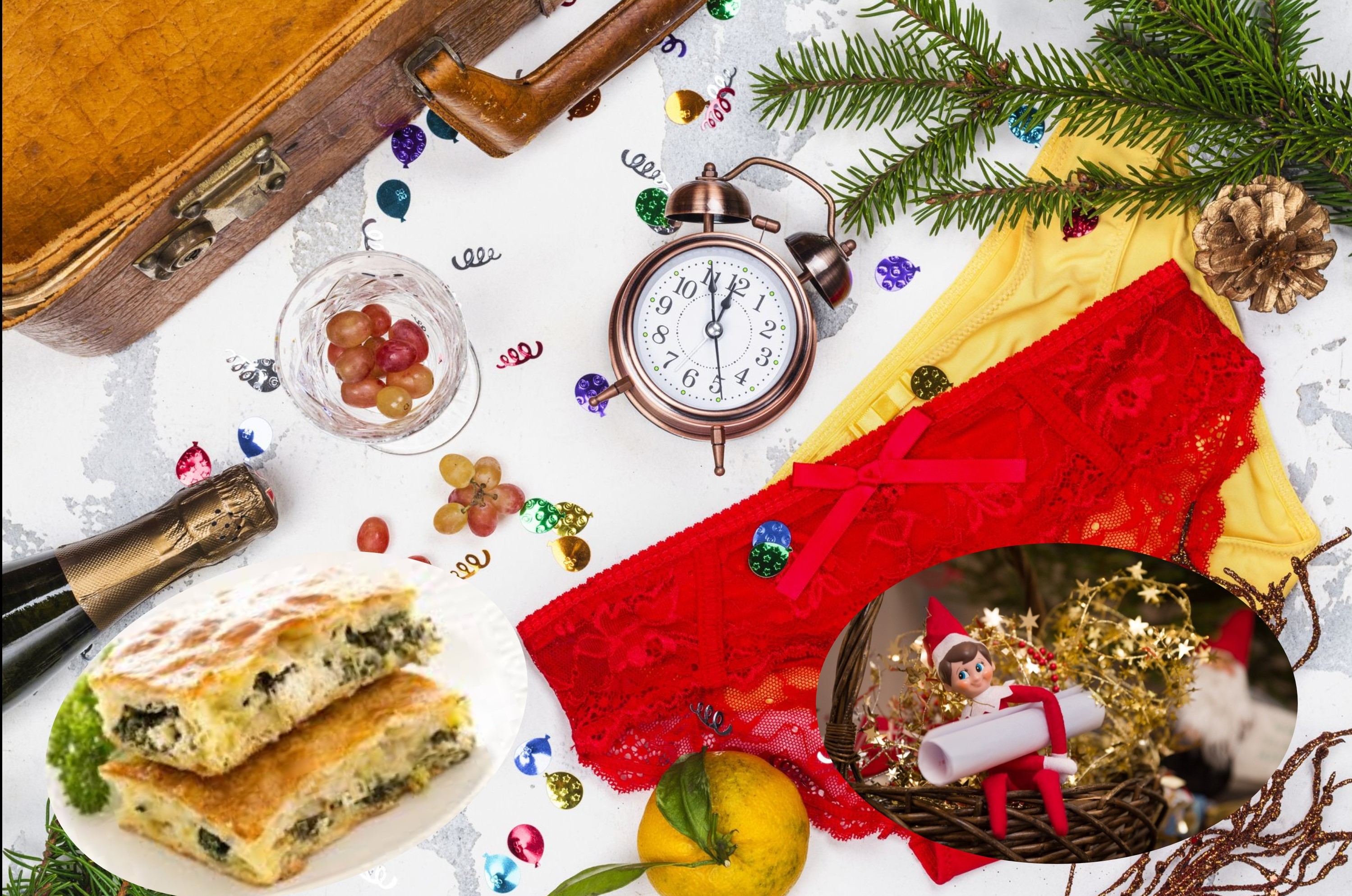
Albanian Byrek and Food Symbolism - In Albania, I grew up with the ritual of the New Year’s Day of eating a homemade cheese or spinach filled byrek, with a twist. While the adults prepared the thin flaked dough pastry, they placed a coin in it before baking. Before serving, one of the adults would slice it still on the pan. My ‘duty’ as the youngest of the family was to name which slice would go to which member, without looking at the pie. I remember shouting out: Mom, Dad, my sisters’ names and so on, while secretly wishing that the piece with the coin would be mine. The excitement of finding who got the coin and therefore the assurance of “a whole good year” would build up around the table. Sometimes seconds would go by as we all chewed through the slice with anticipation. Then we would start joking that maybe someone ate it accidentally. Admittedly we had to be careful not to bite too hard into the slice for fear of chipping a tooth. The person who found the coin was cheered on and congratulated. Years later, the fillo pastry is store-bought rather than handmade, the Albanian leke is replaced by an American coin, and our kids took turns in completing the “duty” assigned to the youngest family member. Yet throughout the decades of living in the US, our family still observes the byrek tradition of the New Year’s Day.
The menu variety depends on what is available in the season but the symbolism is constantly tied to prosperity and well-being, for example eating black-eyed peas, hog jowls and corned beef and cabbage is believed to bring good luck. In Spain, everyone has a grape with every one of the 12 bell strikes. Every TV network connects with the clock tower in Puerta del Sol, Madrid, where thousands of people gather to welcome the New Year. This relatively young tradition that started in 1895 has gained immense popularity. Spaniards believe that eating the 12 grapes at the same pace means you will have prosperity in the upcoming year. In keeping with an old ‘PA Dutch’ (German) tradition, on New Year’s Day, they always eat roast pork and sauerkraut for good luck in the new year. It is usually served with mashed potatoes and applesauce and horseradish for the pork. The popular belief is that it ensures good luck in the new year. In some households, the favorable fortunes for the coming year requires that the first male to enter the house eats some herring. Some families with a Welsh background are set on eating black-eyed peas and greens, as their way to ensure prosperity, whereas others observe the tradition of serving corned beef and cabbage on New Year’s Day every year as a nice meal to start off the new year right and less cliche. For a more straightforward correlation, some cultures just keep bread and money on the table on New Year’s Eve, to ensure you have enough food and money for the new year.
According to a Portugal tradition, eating 12 raisins all together at the same time and making a wish that becomes a resolution for the new year, is a good way to celebrate. Food is a common theme around the world that usher in the new year with fancy dinners with friends or family, champagne, and someone special to kiss and hug.
The Water Metaphor - It is a Cuban family tradition to fill a pot with water and dump it on the street at the stroke of midnight as to clean your house of negative energy. At the stroke of midnight, some throw a glass of water out the front door of the house while taking 10 sips of champagne. It is believed to take all the bad out of the house and one’s life.
Mindful of Clothing - Wearing yellow underwear for the new year is supposed to bring good luck. Also making a dummy out of cloth, dressing it with old clothes as a way of representing the old year and then burning it at the turn of the new year is meant to begin the new year with a new page. For some, washing clothes on New Year’s Day forebodes or invites tragedy in the upcoming year.
Auld Lang Syne - The traditional song for ringing in the New Year in almost every English speaking country in the world is Auld Lang Syne. No wonder some celebrate by singing the lyrics attributed to Robert Burns. Arching back from 1780s, it has become the world’s anthem of the New Year. The message of the song: “Should old acquaintance be forgot, and never brought to mind?” is about preserving old friendships. In apparent contrast with some who like to start the year with a lovely tune of “old time sake”, others just go outside at midnight banging on pots and pans with a spoon. The meaning of the noise-making is connected to scaring away bad spirits. In some cultures, the person with the darkest hair has to go out the back door and enter the front door carrying a loaf of bread for good luck in the next year.
Making a Wish - Some collect loose change and at midnight make a wish for prosperity and throw the money out of the front door as fast as possible. According to popular belief, every year that you do this ritual, you may come into some draining events, but you will always have enough money to get by.
Baby Powder, Haircut as Attribution of Birth - In Fiji it is tradition to throw water balloons and cover your friends with baby powder on New Year’s Day. Water balloons are just fun, and baby powder, is symbolic of being a newborn. In Chinese tradition, the cutting of the hair should be done before the turning of the year. Hair in Cantonese or Mandarin is a homonym with the word ‘wealth,’ so cutting your hair during the new year period means parting ways with your wealth. It is customary not to gift people shoes for new years. ‘Shoes’ is a homonym with the sound of sighing in Chinese, so gifting someone shoes for New Year’s means they’ll be sighing all year.
Open Door Significance - For a tradition that is passed on for at least 60 years, at midnight, one opens the back door to let the old year out and the front door to let the new year in. And if there’s only one door, a window will do.
Jumping Reinterpreted - There is a tradition of jumping over wallets on New Year’s Eve for good luck. For those who live near water, they keep up with the old ritual of jumping seven ocean waves. Some remember that in the days of their childhood they used to stand on the coffee table or a chair and jump into the New Year when the clock hit midnight. Years later, while unable to jump, they hop at midnight before going to bed. At least the new year started with some form of exercise for those of us who are not into fitness.
The Cleaning Symbolism - There is a southern Italian tradition of wearing a pair of new, red underwear. on. In Scotland, the house must be cleaned top to bottom. Everyone must shower and put clean clothes on close to midnight. They leave a piece of cake by the front door for the first footer (they must be a tall, dark-haired person) to cross the threshold. Sitting by an open window at midnight, they listen for the bells or the town hall clock ringing in the new year. It is believed that you and your home will be clean all year, and the first footer brings luck to the home.
Starting a Tradition One does not need to be bound by any settled rituals. Instead starting your own tradition may help deal with the extraordinary year we passed. For some it is as easy as making a big bowl of popcorn, pouring a glass of wine, and gathering your pets (if any), to watch Marx Brothers movies. Such inventions may stem from childhood days when parents would host a poker party and banish kids to their bedrooms with a little black-and-white TV playing Marx Brothers Movies marathon.
This collection of a wide range of traditions, personal or collective, centers around the concept of prosperity and health, which were broadly affected by the worldwide pandemic in the year 2020. There is renewed interest in our well-being and how we get there. The emphasis is on making renewing an intention and practicing beginning again.
©Rafaela Prifti - MA Cultural Anthropology